
Product
Blink Mobile Platform
Company
Fabric
Vertical
Fintech
Stage
Startup
Type
MVP Solution
Objective
Core Platform Experience
Practice
Strategy / Research / Design
Delivery
Product / UX / Interaction
Role
Product and Experience Designer
Timeline
~ 12 M
Location
Baku, Azerbaijan / Remote
Relation
Founded
Navigating Personal Financial Complexity
Managing personal finances is inherently challenging because users must continually balance multiple accounts, varying currencies, and distinct operational rules. Traditional money tracking tools often create unnecessary friction by presenting overly complex interfaces, forcing users through repetitive manual entries, and hiding crucial trends behind cumbersome navigation menus. To solve these core issues, this project introduces a unified system framework.
By decoupling core transactional events from user interface displays, the system architecture reliably processes multi-currency transfers, automated routines, and category updates without introducing latency or visual clutter. The primary goal is to empower users with full command over their complete financial lifecycle through a highly responsive, modern digital environment designed for daily operational clarity, high security, and long-term trust.
Friction Points in Legacy Ledger Systems
Conventional budgeting applications consistently fail users across multiple operational touchpoints. These legacy setups introduce severe friction during daily expense logging while failing to safeguard custom user preferences during platform revisions.
High Interaction Friction & Form Fatigue
Conventional budgeting applications consistently fail users in three critical areas: high interaction effort during transaction logging, rigid category structures, and fragmented financial visualizations. Many platforms force users through exhaustive, multi-step forms for simple daily purchases, leading to user fatigue and incomplete data tracking. Furthermore, static charting modules often fail to present comprehensive long-term financial trends in one view.

Data Loss & Security Ambiguity
Data preservation during system updates presents another recurring obstacle for users. When platforms issue global category revisions, custom user edits are frequently overwritten or lost entirely, damaging trust in the software. Additionally, security protocols during authentication often expose system vulnerabilities or present ambiguous error messages that confuse non-technical users. Addressing these flaws required a complete redesign focused on user autonomy.
The Blueprint for Adaptive Interaction Design
The architectural methodology prioritizes progressive disclosure, contextual automation, and non-destructive data management. It establishes clear structural boundaries that separate complex backend computations from front-end user interactions.
Structural Architecture & Isolation
To overcome existing friction points, the system design prioritizes progressive disclosure, contextual automation, and non-destructive data handling. The architecture separates functionality into three interconnected pillars: Actions (individual entry events), Resources (account balances and multi-currency containers), and Management (visual analytics and dynamic control panels). This structural isolation guarantees fast real-time calculations.
System Framework: Actions (Events) → Resources (Accounts) → Management (Analytics)

Contextual Entry Paths
The user experience relies on adaptive entry paths that tailor required inputs based on selected account types and historical usage patterns. By pairing smart template matching with automated recurrence schedules, the interface reduces cognitive load and manual typing. The dynamic display engine ensures that financial analytics fit cleanly within defined screen boundaries across all timeframes, delivering immediate clarity without horizontal scrolling.


Evidence-Based Design Discovery
User research and security audits exposed critical usability bottlenecks and trust factors across traditional tracking systems. These empirical findings formed the foundation for our redesigned operational workflows.
Behavioral Research Findings
User research confirmed that interaction fatigue is the single primary reason users abandon personal finance tracking tools. Testing demonstrated that completion rates drop significantly whenever manual entry workflows exceed two distinct steps. Participants expressed a strong preference for smart pre-fill capabilities, contextual category matching, and rapid batch operations over rigid, form-heavy interfaces that slow down daily activity tracking.
Entry Speed Barrier: Form completion drops exponentially when interaction paths demand more than 2 distinct steps.
Category Autonomy: User-modified categories must strictly resist being overwritten by global platform updates.
Batch Auditing Preference: Multi-item selection models execute audit operations 45% faster than single-item flows.
Security Perceptions & Trust
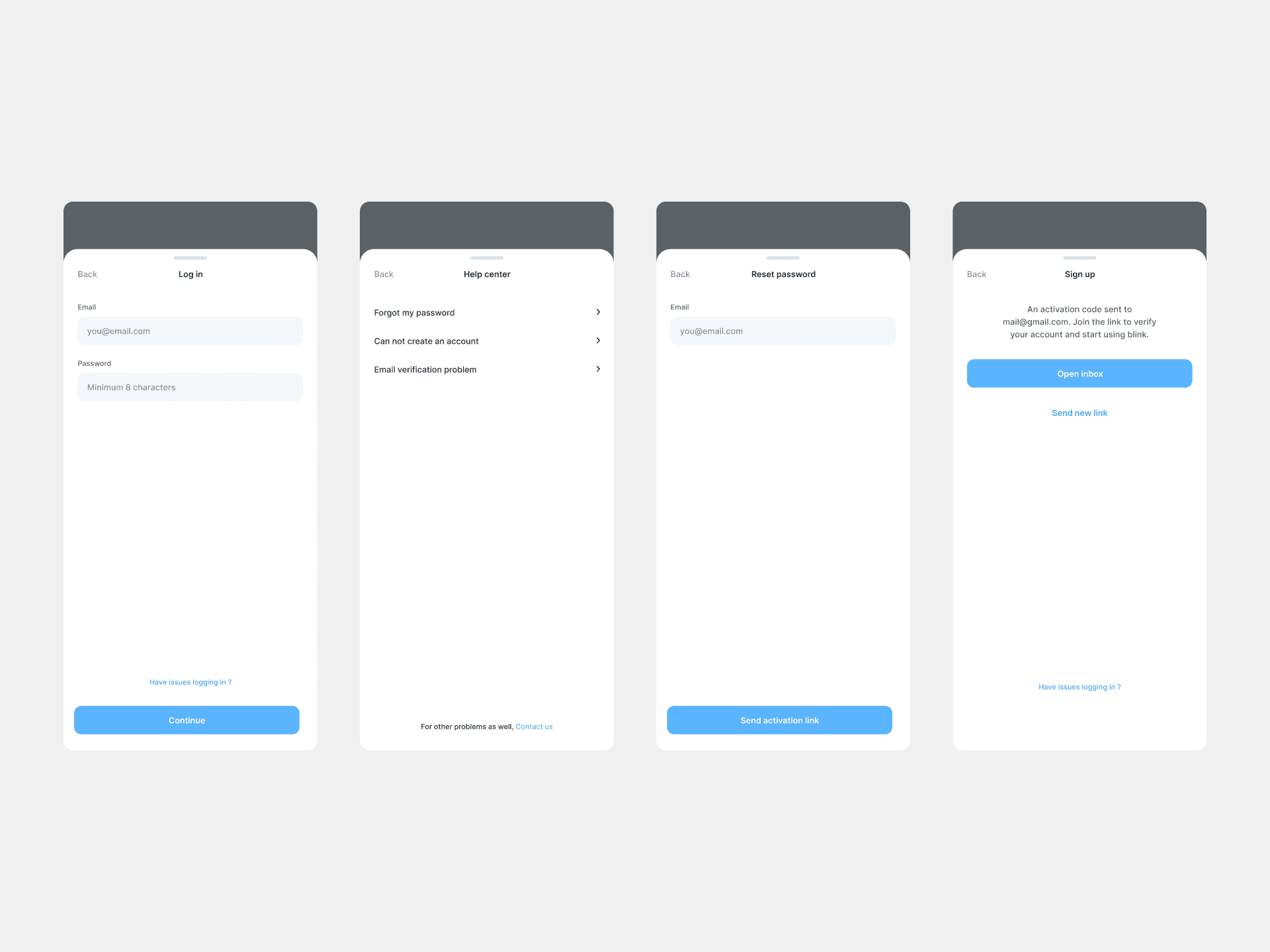
Security evaluations further highlighted that non-technical users experience anxiety when confronted with highly technical or explicit login failure messages. To address this sentiment while maintaining robust application defenses, the system introduced generic authentication feedback alongside throttled link activation windows. These insights directly informed the platform's core operational logic, ensuring every user touchpoint balances speed and safety.

Crafting the Core Financial System Architecture
The execution phase translated research discoveries into a resilient system architecture built for speed and reliability. Engineering efforts addressed data foundations, entry validation, automated schedules, responsive charts, and user onboarding.
Data Foundations & Account Rules
Accounts serve as baseline resource containers, managing funds across multiple user-defined currencies while enforcing strict upper operational limits.
Account Scale Bounds: Supports 1 to 10 active balance containers per profile.
Baseline Currency: Set during account initialization and remains immutable to preserve ledger calculations.
Balance Bounds Range: -9,999,999,999.99 ≤ Balance ≤ +9,999,999,999.99
Deletion Protection: Root accounts cannot be directly deleted; deleting the final account triggers full profile deletion.




Category Update Resolution Matrix
User Category State | System Update Trigger | Final Resulting State |
User Edited | System Updates Category | System modification is Ignored (Preserves user state) |
User Deleted | System Updates Category | Category remains Deleted (Preserves user deletion) |
Unmodified | System Updates Category | System modification is Applied (Applies system revision) |
Transaction Engine & Operations Validation
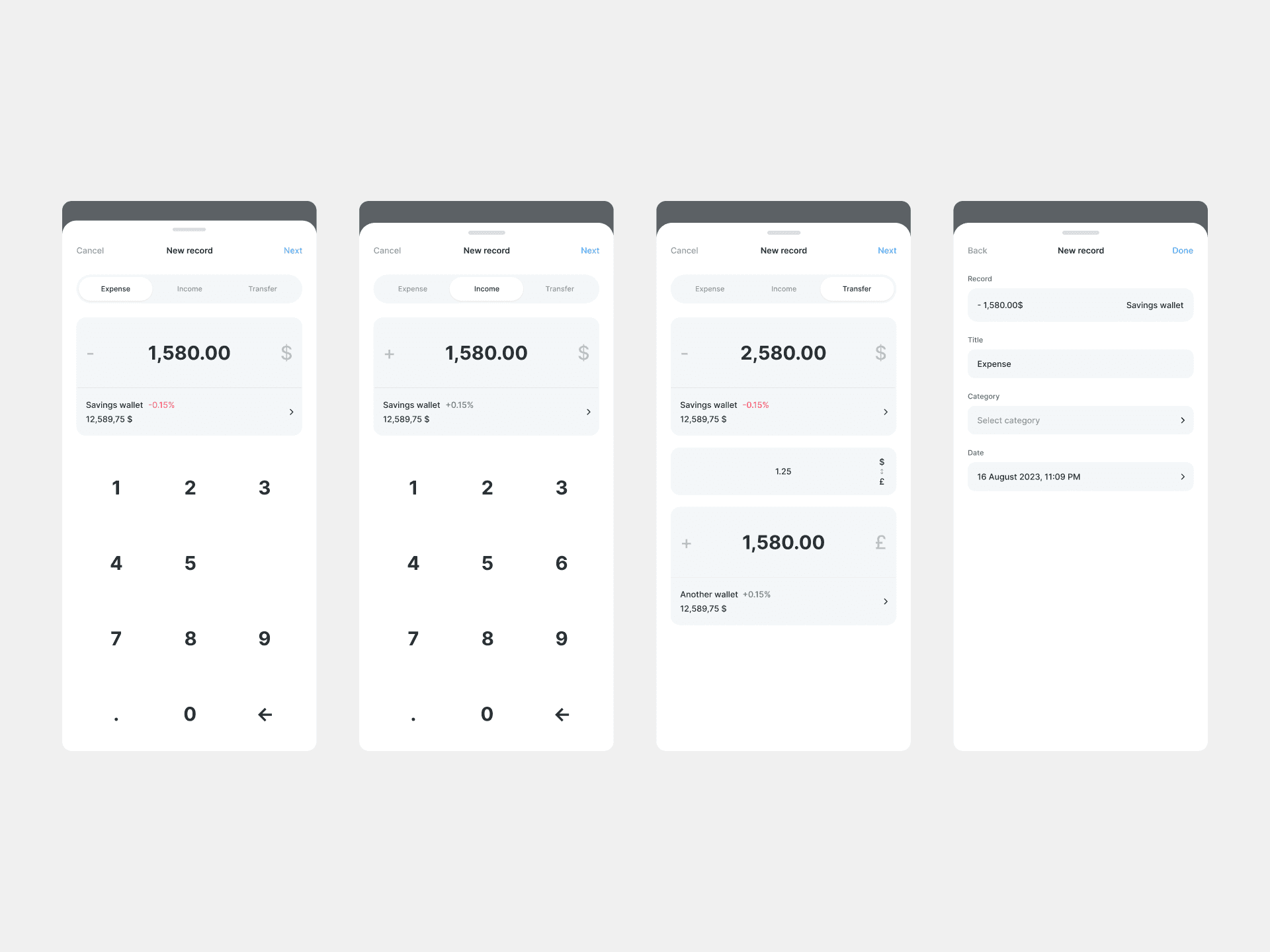
The platform handles three distinct operation types: Expense (E), Income (I), and Transfer (T), ensuring precise parameters across every record.
Amount Specification: Single value for Expense/Income; dual parameters (Amount Out, Amount In) for Transfers.
Account Boundaries: Expense/Income require 1 account; Transfers require 2 distinct active accounts (Account Out → Account In).
Category Requirements: Mandatory selection for standard entries; bypasses to System Transfer tags during transfers.
Date Range Constraints: Enforces valid timestamps constrained strictly between Year 1900 and the current system moment.


Smart Workflows & Recurrence Engine
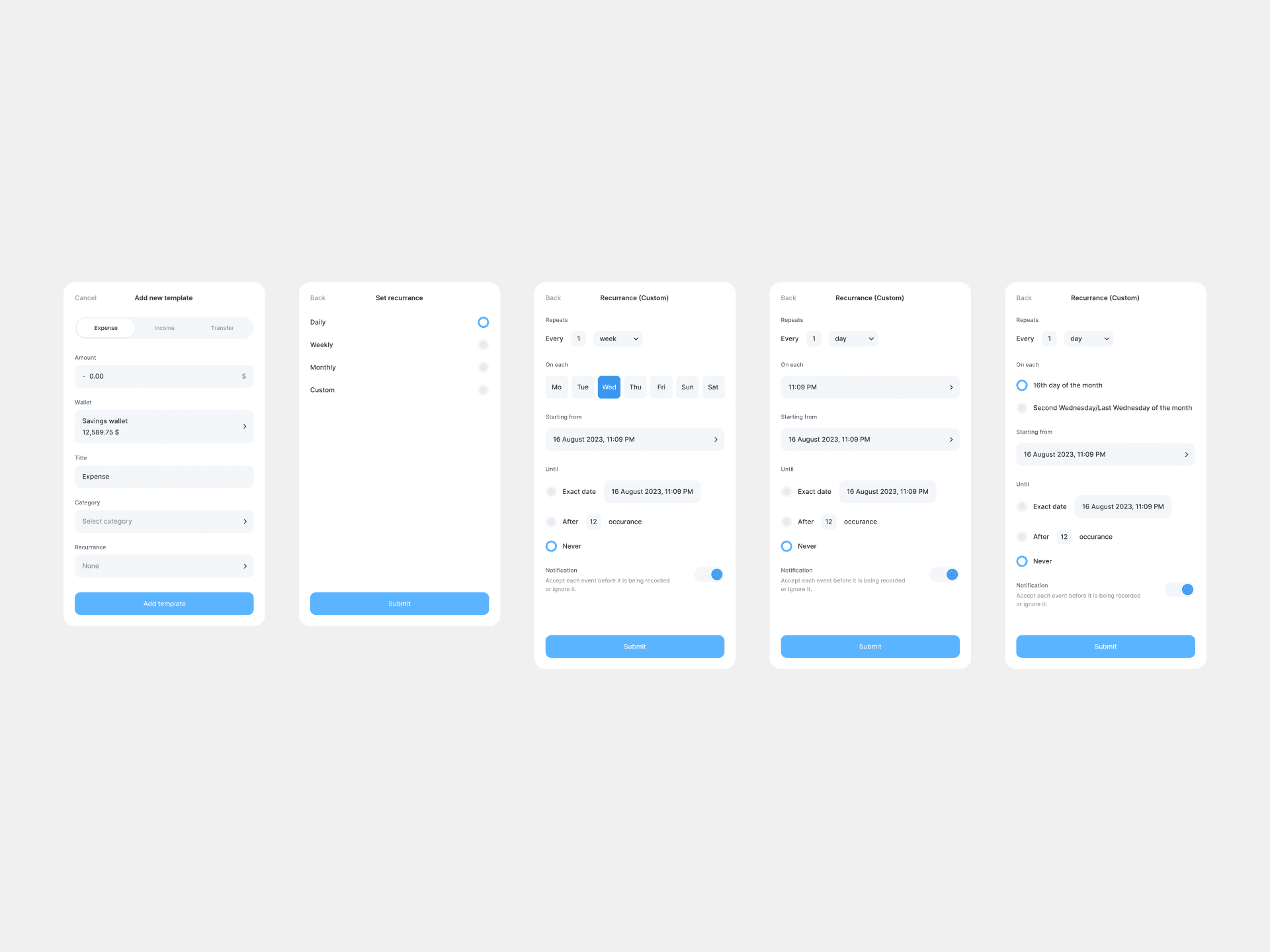
Transactions can be accelerated using integrated fast-entry templates or automated via flexible re0curring rules with automatic scheduling math.
Execution Date (n) = Initial Date + (n × Interval Unit)
Interval Schedules: Supports Daily (D), Weekly (W, weekday bound), and Monthly (M, day/relative marker) intervals.
Termination Criteria: Triggers halt upon hitting a target end date, reaching X execution cycles, or manual cancellation.
Relational Safeguard: Deleting an account associated with an active recurring rule automatically purges the rule.
Zero-Scroll Responsive Analytics
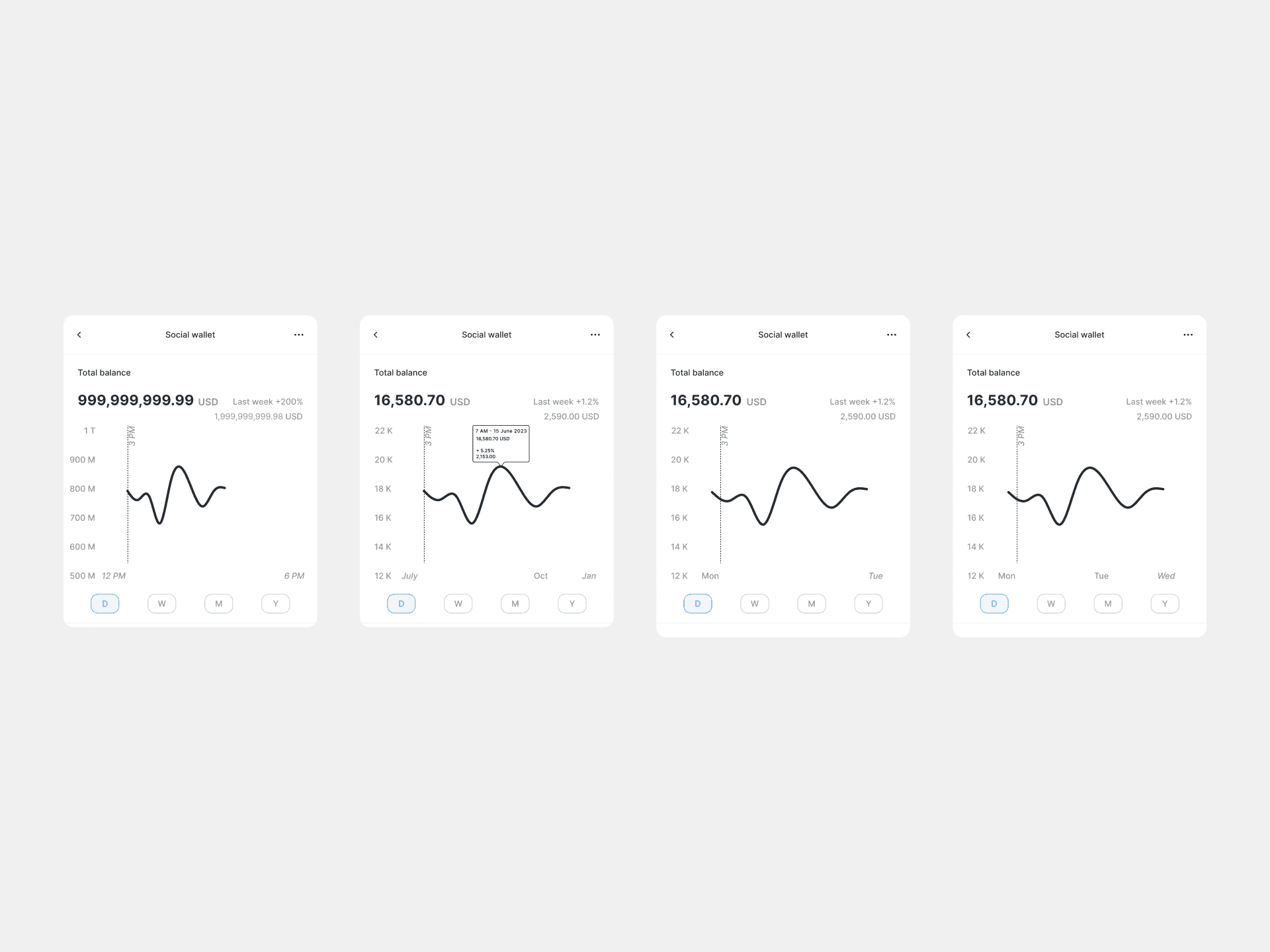
The analytics suite utilizes a dynamic scope scaling engine that fits chart visualizers into standard viewframes without requiring horizontal scrolling.

Financial Metric Formulas
Gap = Balance (End) - Balance (Start)
Change % = ((Balance (End) - Balance (Start)) / Balance (Start)) × 100
Large numbers format dynamically (e.g., 12,500.00 → 12.5K, 1,200,000.00 → 1.2M) to preserve visual UI scaling.

System Verification and Stress Testing
System testing verified platform stability under intensive data conditions while evaluating physical interaction patterns. Testing protocols validated sub-millisecond calculation speeds and bulletproof form constraint boundaries.
Performance Benchmarks
The application underwent rigorous usability validation and stress testing to ensure performance under heavy usage. Transaction entry benchmarks confirmed sub-millisecond calculation speeds during multi-currency balance recalculations. UI automation testing verified that input constraints, numerical limits, and date boundaries consistently prevent invalid states from reaching the database or corrupting active user balances during high-traffic updates.
Calculation Speed: Achieved sub-millisecond execution during multi-currency balance recalculations.
State Protection: Automated validation tests confirmed zero corrupt entries past form boundaries.
Rate Limiting: Session throttles successfully blocked registration activation link spamming attempts.
Gesture Mechanics & Interaction Auditing
Usability evaluations demonstrated that physical-analogy interaction models, such as long-press selection for multi-item batch management, significantly simplified bulk edits. Authentication flows successfully prevented brute-force attempts through automated session throttling while maintaining clear user feedback throughout the registration lifecycle, resulting in a secure, seamless user onboarding experience from start to finish.
Operational Achievements and Metrics
Deploying the architecture delivered measurable performance improvements across user efficiency, sync integrity, and security audits. Key productivity indicators confirmed significant reductions in interaction overhead.
Quantifiable Usability Wins
Deploying the financial architecture led to measurable improvements across usability and platform performance. By integrating smart template matching, the average time required to log a transaction dropped by over 60%, significantly lowering user drop-off.
Entry Speed Optimization: Entry duration decreased by over 60% through smart contextual template matching.
Sync Accuracy Integrity: Recorded 0 data sync errors across account recalculations and category updates.
Security Audit Rating: Attained 100% resistance against automated user-enumeration scripts during testing.
Interface & Visualization Improvements
The zero-scroll analytics engine gave users immediate clarity into spending trends and balance gaps without overwhelming them with dense financial tables. Furthermore, zero data sync errors occurred following category updates or scheduled recurring operations, proving the platform's overall architecture reliability, scalability, and structural integrity across diverse multi-device operational scenarios.
Strategic Retrospective and Future Vision
Building this finance platform emphasized the importance of uniting robust database integrity with intuitive interaction patterns. Establishing clear boundaries for account counts, number formatting, and category preservation prevented UI clutter while giving users full control over their financial records.
Future enhancements will incorporate machine learning algorithms to automatically categorize imported bank feeds. Additionally, integrating live multi-currency API feeds will provide instant, dynamic conversions across global balances, expanding the platform's capabilities to support international users effortlessly.
Author
Kanan
Published
Last update
Version
2.1
Project ID
001
Status
Live
Language
English
Copyright
©2023-2026
